




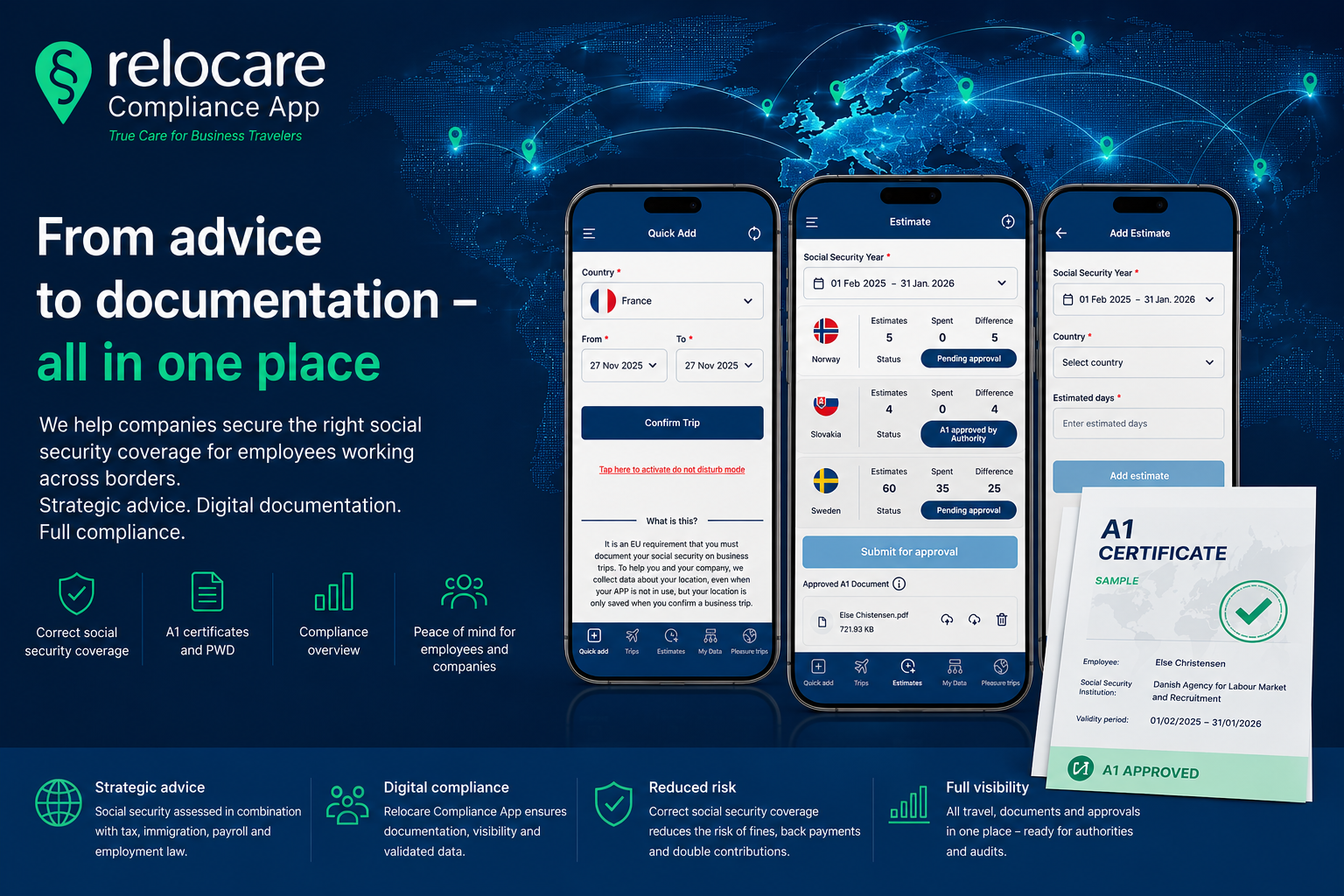
EU adopts new A1 rules – but does less notification mean less compliance?
The Council of the European Union has adopted a long-awaited revision of the EU social security coordination rules. The reform is intended to reduce unnecessary administration for genuine business trips and certain very short activities. But fewer prior notifications will not remove the need for employers to understand and document cross-border work.
What has the EU adopted?
The revision amends Regulation (EC) No 883/2004 and Regulation (EC) No 987/2009, which coordinate national social security systems when people live or work across borders.
According to the Council’s final approval, the reform covers several areas, including the legislation applicable to posted workers and people working in two or more Member States. The final adopted text, PE-CONS 29/26, is currently the authoritative text available before publication in the Official Journal.
A new distinction between business trips and operational work
The adopted text introduces a definition of a genuine “business trip”. It covers a temporary, time-limited activity connected with the employer’s business interests, but excludes the provision of services or delivery of goods. The definition expressly includes activities such as attending business meetings, cultural and scientific events, conferences and seminars, and receiving training.
This distinction matters. A meeting, conference or training session may qualify as a business trip, while travelling to install equipment, carry out a customer assignment or otherwise deliver the employer’s service may not. The destination and duration alone are not enough; the employee’s actual activity must be understood.
For genuine business trips, the revised implementing rules remove the obligation to provide prior information to the competent institution and request the relevant attestation. They also introduce an exception for activities lasting no more than three consecutive working days within a period of 30 consecutive days. That short-term exception does not apply to construction-sector activities, which are defined broadly in the adopted text.
These are exceptions from the prior notification and attestation procedure. They do not turn cross-border work into a compliance-free area, and they are not yet applicable. Under the adopted text, the relevant provisions are due to apply 24 months after the regulation enters into force.
No A1 application does not mean no documentation
Where an employer relies on an exception and no A1 attestation has been issued, the employer remains responsible for producing evidence if requested by the competent institution in the country where the activity took place. The supporting evidence may be provided on paper or electronically.
The practical compliance question may therefore increasingly change from:
“Have we obtained an A1?”
to:
“Do we know enough about this trip to determine whether an A1 is required – and can we document our conclusion?”
To answer that question, employers still need reliable information about:
- where the employee travelled;
- how long the employee stayed;
- how frequently the employee works across borders;
- the purpose of the trip; and
- what the employee actually did while abroad.
This becomes especially important for employees who work in two or more countries. One isolated journey cannot always be assessed without understanding the wider working pattern.
Where the new rules can genuinely help
Relocare welcomes the attempt to remove unnecessary administration. The clearest practical benefit may be for an employee who does not normally travel internationally but attends a one-day meeting, conference or trade fair in another EU country.
Historically, this is precisely the type of incidental journey that can fall below an organisation’s compliance radar. A genuine business-trip exception can make the rules more proportionate. For organisations with frequent international mobility, however, structured processes remain necessary because the employer must still distinguish incidental business trips from service delivery, operational work, repeated travel and multi-state working.
Relocare’s specialist view: waiting for less regulation is not a strategy
The revision began with a Commission proposal in 2016 and has taken almost a decade to reach final adoption. During that period, international working patterns have continued to become more complex.
Relocare’s view is that companies should not build their international mobility strategy around the hope that European compliance requirements will disappear. The likely direction is fewer unnecessary manual procedures in some areas, combined with more data, greater transparency, stronger cooperation between authorities and a higher expectation that employers can explain where employees worked, what they did and why a particular compliance treatment was applied.
This assessment is consistent with the wider direction of the reform. The European Commission’s explanation of the agreement highlights improved information exchange, clearer verification procedures and stronger tools against fraud, abuse and error. The adopted text also provides for electronic comparison and exchange of relevant information between national institutions.
Why cross-border compliance will not simply disappear
Social security coordination is not merely about forms. EU rules coordinate national systems; they do not replace them with one European system. As the Council explains, the framework is designed to ensure that a person is subject to one country’s social security legislation at a time and is not left without protection or subject to double coverage.
When an employee works across borders, authorities and employers must still address fundamental allocation questions:
- Which country receives the social security contributions?
- Where may taxation rights arise under separate tax rules?
- Which country’s system carries responsibility if the employee becomes sick, unemployed, requires benefits or suffers a work-related accident?
In Relocare’s assessment, these underlying financial and protective responsibilities are a central reason why cross-border compliance will evolve rather than disappear.
Compliance is increasingly a commercial issue
An A1 certificate or Posted Workers notification may look like an administrative HR document. But when compliance affects access to a worksite, performance of a customer contract or the conditions imposed in a public procurement, it becomes a business issue.
In Denmark, section 137 of the Public Procurement Act permits contracting authorities, where the relevant optional exclusion ground has been included, to exclude an applicant or tenderer if the authority can demonstrate a breach of applicable environmental, social or labour-law obligations. This does not mean that a missing A1 certificate automatically leads to exclusion. It does demonstrate that compliance failures can become relevant in procurement under defined circumstances.
Sweden provides an even more operational example. The Swedish National Agency for Public Procurement advises that procurement documents and contracts may address Posted Workers registration and may require a valid A1 certificate where one is required for the relevant period. Its guidance also describes contractual mechanisms and follow-up intended to counter work-related crime.
Relocare’s specialist assessment is that companies able to answer the following questions will increasingly be better positioned than those that deal with compliance only after travel has taken place:
- Where are our employees working?
- For how long?
- What are they actually doing?
- Which compliance requirements are triggered?
- What decision did we make?
- Can we document why?
Compliance infrastructure can therefore become a competitive advantage: not because every trip requires the same form, but because the company knows rather than guesses.
Technology should manage the structure and documentation. People should make the professional assessment.
Technology can identify travel and cross-border work, structure relevant data, recognise patterns, retain documentation, apply workflows and flag situations requiring professional assessment. But legislation and real employee situations do not always fit neatly into an algorithm.
Professional assessment remains essential, particularly for repeated travel, work in multiple countries, complex employment structures and situations where the distinction between a business trip and service delivery is not straightforward.
This is the principle behind the Relocare Compliance App and Relocare’s Social Security and A1 support: technology provides structure, visibility and documentation, while specialists assess the circumstances and support the required action.
What should international employers do now?
The new exceptions are not yet applicable. Employers should continue to follow the current A1 rules while preparing for the future framework.
A sensible preparation programme includes:
- capturing international travel before it takes place;
- recording the purpose and actual activity of each trip;
- identifying repeated travel and multi-state work;
- connecting A1 assessments with Posted Workers compliance, tax and shadow payroll; and
- retaining the evidence behind decisions, including decisions not to apply for an A1.
These areas form part of a wider Global Mobility compliance framework. Social security is one part of the picture; immigration, Posted Workers requirements, tax and payroll may still apply independently.
Fewer applications may be coming. Less compliance is not.
The reform is a welcome attempt to remove unnecessary administration. Companies may eventually submit fewer A1 applications for genuine business trips and certain very short activities.
But they will still need enough information to determine why an A1 was or was not required—and enough documentation to support that conclusion if asked.
Relocare’s advice to international employers is simple: do not wait for compliance to disappear. Build the infrastructure to manage it.
Fewer A1 applications may be coming. Less compliance is not.